Showing posts with label Norway. Show all posts

Wednesday, June 3, 2015

Tending Graves


When I was in Norway, I spent a lot of time visiting churches and churchyards. The churchyards were incredibly well maintained by the family members who tended the graves of their relatives. No matter what time of day or what day of the week I happened to visit a church, someone was there at a grave site watering, trimming faded blossoms, planting new flowers, or cutting the grass. 

Some grave yards had little grave-tending stations set up with a water spigot, watering cans, a trowel and trimming shears. Sometimes I would encounter whole families cheerfully sprucing up the family graves. One day, late in the afternoon, I saw a woman who evidently had come straight from work. She was dressed for the office, had her handbag with her—and her gardening gloves. She must have thought when she left work, “Oh I have a few extra minutes. On my way home, I'll just stop by and trim around Granny's grave—the grass will be getting a little high.” She was the only one there that day, and it was so peaceful among the gravestones of various design, a gentle breeze tossing the branches of the bushes that gracefully dotted the churchyard. I could see how people would be drawn to spend a little time at the end of the day in the presence of their by-gone companions—and of ancestors they may never have met but had always known through the family tradition of visiting and tending their resting places.

The first time I encountered folks tending graves was the day that I went with three other members of our Valdres ancestor-hunting group—in a car. (After days of being herded on and off buses to visit sites of ancestral interest, it was such a relief to be in a little car with only three people.) One of them, Linda, wanted to go to look at the church in the town her family had called home. Wyonne, the driver, was a Minnesotan who had lived in Oslo for twenty-five years and therefore spoke Norwegian. We arrived at the church to find it locked so Wyonne, who is not a shy person, approached a little knot of people in the churchyard. They were variously watering, weeding and cutting grass. It was a mother, father, a couple kids, and the grandmother. They communicated to Wyonne that the caretaker was away, but maybe his son could be reached. They helped Wyonne call him on their cellphone and she managed to talk him into coming to unlock the church for us. She hung up and announced that he'd be arriving on his motor scooter in ten or fifteen minutes.

In the meantime we hung out and watched the family leisurely enjoying themselves in the beautiful churchyard on that beautiful day. They would take breaks now and then. Sit down on the ground or, in the grandmother's case, on a nearby bench. Chat. Have a snack. Wander around through other sections of the grave yard. It wasn't like they were hurrying to finish a chore so that they could get it over with and move on to a more exciting activity. This was the activity. Occasionally we would all smile and nod and gesture at each other in the awkward, well-meaning way people do when they can't communicate with words.

Eventually Anfind roared up on his motor scooter, grinning and nodding. And then we got our own personal tour of the church, with Wyonne relaying our questions to him. Then Linda, Floyd, and I would wait forever for her to do the translation of his answers. We had to be patient, partly because she would become so involved in the conversation with the very entertaining Anfind that she would forget we were waiting. And partly because she couldn't get him to stop talking—he was having such a good time telling her stories and jokes. So the two of them were having a knee-slapping time while we stood by, watching and laughing. Periodically we were let in on the fun.

We found out that Anfind and his father (who was in his 80's) dug the graves by hand. When he wasn't digging graves, we wondered what else Anfind did.

Anfind: Well, I get the church ready for weddings.
Us: How do you do that?
Anfind: Oh, I set up the chairs at the altar.
Us: Show us how!

So he demonstrated and described how the whole wedding was conducted. In the beginning of the ceremony, the chairs are set so that the bride and groom face each other across the aisle in front of the altar. After they make their vows, the groom's chair is moved so that he and his new wife are seated next to each other, symbolizing their new union. When we learned about that part, we made Anfind move the chairs side by side so that Linda and her new husband could sit next to each other. And then I took a picture of the seventy-something newlyweds. Next, Wyonne asked Anfind if, since Floyd was a pastor, she could take a picture of him standing up in the pulpit. Of course the affable Anfind agreed and smiled and laughed along with the rest of us as Floyd gestured from the pulpit. We all had such a good time. We hated to say good-bye. But we had other churches and churchyards to visit—and it was Anfind's day off. So we smiled and nodded and waved him off on his motor scooter. We said our good-byes (ha det bra), and our thanks (takk) to the grave-tending family and then piled into the car to continue on our way.
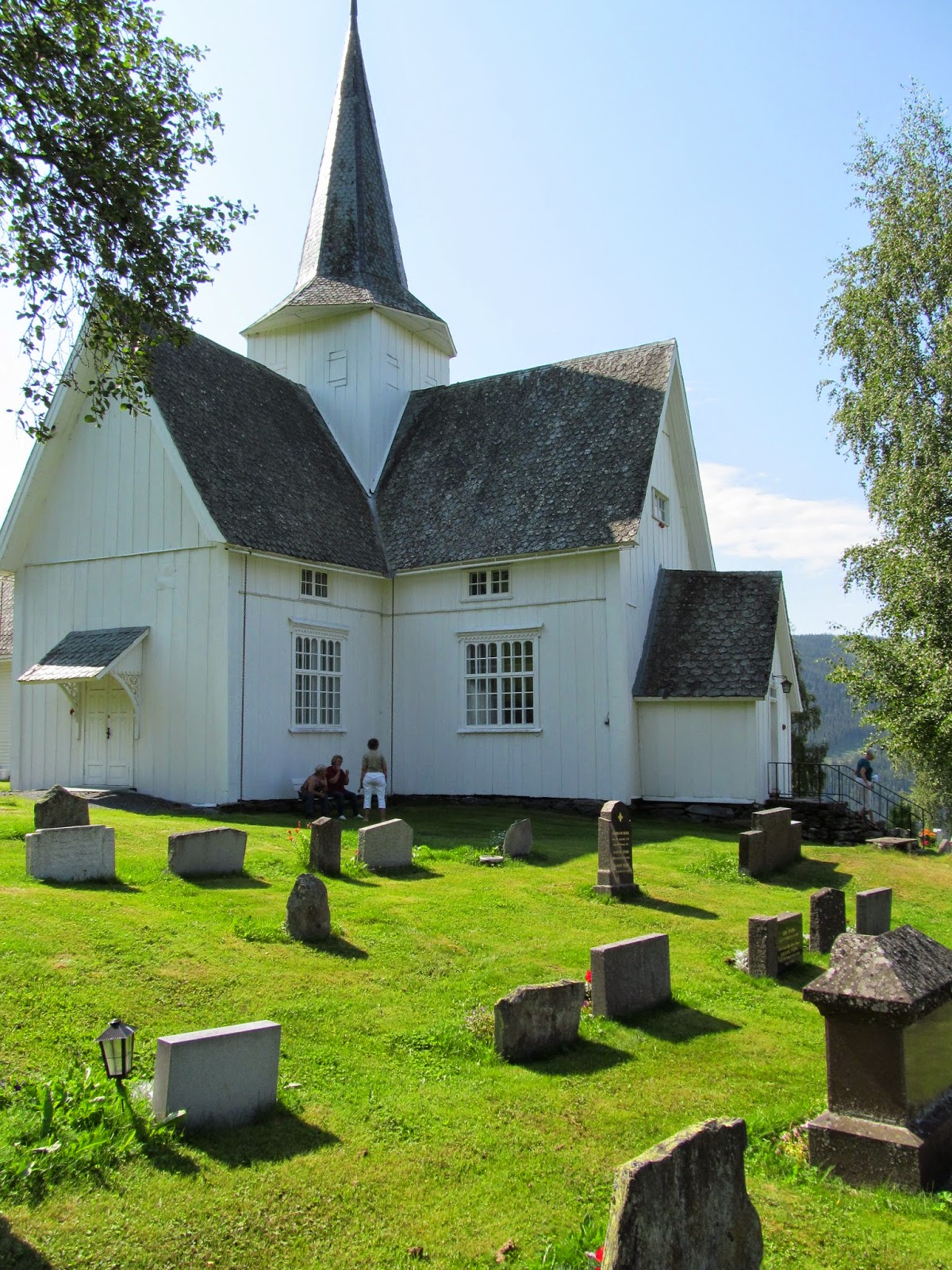
Skrautval church and gravestones

Tuesday, October 14, 2014

A Hedalen Baptism

Hedalen Stave Church

Two months ago, I was sitting in the pews of the 12th century stave church where my great-grandfather Helge had been baptized and confirmed. His mother Barbro had been baptized, confirmed and married there. Her parents—baptized, confirmed, married and buried. 


I had been looking forward to this event since the time I started planning my Norwegian ancestor- hunting expedition. The group of people I was traveling with all had ancestors from the region called Valdres, and we had spent the week visiting each Valdres town—six in all—and its corresponding church: Vang, Oystre Slidre,Vestre Slidre, Etnedal, Nord Aurdal, and now the Hedalen church in Sor Aurdal. In each town the group members with ancestors there would say, “This is my home church.” I had been patient and polite through five visits to other people's churches. Now finally, in Hedalen, it was my turn to say, non-churchgoer that I am, “This is my home church.”


I felt particular pride in having the only stave church in Valdres to call my home church. Built in 1160, it is still standing. It had been altered, added on to to allow for the growing congregation, but there it still stood on its original site. It was the last church we went to and, as the visit fell on Sunday, we were invited to attend the service. And, as if that weren't exciting enough, there were to be two baptisms that day. This old agnostic was all agog anticipating the experience.


Two baby girls were brought to the center of the church where the baptismal font was located. They were accompanied by their entire families: parents, grandparents, god parents, siblings—all in their traditional regional costumes or “bunads”. The minister started in on the first infant, addressing her tenderly as the little girl was held in the familiar arms of a family member. Then came the moment when she was transferred to the minister's arms to be cradled for the next stage of the ritual. I braced myself for the inevitable outcry, but the baby simply looked interestedly into the face of this new person. There was commentary throughout, of which I understood not one word (well maybe “gud”), but I caught the gist.


Sometimes the minister addressed the whole family, sometimes the parents, sometimes the congregation at large. And then the time came when she looked directly at the baby and spoke lovingly to her. The baby studied her face, totally open to this novel experience. The minister removed the little white cap to reveal a shock of dark hair (yes, there are non-blondes who are sometimes referred to as Black Norwegians) and the dousing began. Still no objection from the baptizee—she and the minister held each others' gaze throughout. Then the minister triumphantly held the infant aloft, facing her outward toward the assembled witnesses. I'm sure her words told them, “Here! This baby is now in your keeping—you are her community, her protection, her family.” While everyone beamed, the baby girl was handed over to her godmother who looked to be about twelve years old.


And then the whole process began with baby #2 and I got to experience the wonderful ritual all over again—this time knowing what to expect, anticipating my favorite parts, memorizing the looks that passed between minister and babe. The second subject was as cooperative as the first and all ended happily, with the exception of a meltdown on the part of a two-year-old sibling who had had enough of standing around in uncomfortable clothing. An exuberant procession of both families down the center aisle, accompanied by the jubilant ringing of church bells, had me thinking wistfully that there definitely were perks to being a Lutheran.


Detail of Door

Monday, October 6, 2014

How I Ended Up in Norway


 Here is something I wrote way back last March, when the idea of going to Norway first presented itself.


A year ago I had just gotten back from Argentina and was already planning my next trip down there when I would stay for a whole month. But when November rolled around and it was time to start looking for flights and finding a cat sitter, I realized that I didn't want to go any more. I gave up my plan of a month of tango in Buenos Aires so that instead I could go to...wait for it....Illinois, Iowa and Wisconsin! Whoopee! 


If I were telling you this out loud I could use that weighing hand gesture that people employ when they're comparing something delightful with something dubious or downright undesirable. Like attending a concert by your favorite performing group...heft, heft...or going to the dentist for a root canal...heft, heft. An eye brow is usually lifted as part of the hefting, weighing, considering process. Like, “Really?” So yes, I passed up Argentina because I'd rather go poke around in libraries, county courthouses and cemeteries in the Midwest.


At least that was my plan until recently when I made a slight alteration based on some information I received from a Norwegian-American genealogy group about some upcoming events. They're called stevnes—don't really know how the word is pronounced or translated, but basically it seems to mean a convention of Norwegian-Americans. This information came in the form of real hold-in-your-hands newsletters. It seems the Norwegian-American associations are just beginning to venture into the world-wide-web world and still conduct most of their communications with letters and envelopes and stamps and trips to the post office.


The first stevne described caught my interest because it was being held in Austin. “Oh,” I thought, “I could visit my cousin in Austin—I haven't seen him since I was about 10 years old. And Austin sounds like a cool place—my friend Lani liked Austin.” Then I noticed it was Austin, Minnesota. Oh...Well that could still be good—let's see what the plan is. I read an account of a previous stevne to get an idea of the agenda. It got a little scary. One of the major attractions of that particular stevne was a visit to the site where the largest lefse had been made—it made the Guinness book. A lefse evidently is a large round unleavened pancake-like bread, and there was a grainy photo showing the stevne-goers gathered around what looked like a large circular concrete pad. Was it a monument to the mighty lefse? Or was it the very griddle (a concrete griddle?) that the record-breaking lefse had been baked on? So.... if that was the highlight of that particular stevne, what other activities went on during the week-end? Well, it looked like there were a fair number of religious activities: Norwegian Table Prayer recited before the festive final banquet, Norwegian hymn singing, a memorial service for those members of the group who died during the previous year. In addition to being religious, these people seem to be quite patriotic too. At the beginning of many of the events both the Norwegian and the American national anthems are sung.


Could I do this? Could I spend several days with people for whom being Norwegian, Christian and patriotic seems to be the bedrock of their lives? And why, you may ask, would I even consider it? Well, because a main feature of this gathering is to share genealogical information. The group has its resident genealogist who owns every copy of every relevant book of church records from Hallingdal, the region where our ancestors lived. And she brings them all—cratefuls of them—along with her considerable knowledge and expertise to the stevne. So that would be the big draw for me. Even being a little worried about the praying and the singing, I could probably manage most of what's on the agenda for this year's stevne in Austin. But I can tell you right now, I would definitely take a pass on the visit to the Spam Museum. Austin Minnesota, of course, is home to the Hormel meat-packing company. And yes, a field trip is on the schedule.


As it turns out, though, my plans have taken another detour since I learned of a stevne that another Norwegian American group has scheduled—IN Norway! This group has ancestors from the Valdres region which abuts the Hallingdal region--kind of like Iowa and Illinois except without the Mississippi River running between them. Some of my ancestors were born in Valdres and married others born in Hallingdal, so I sort of have dual-citizenship and can chose between stevnes. There might still be the hymn singing and the grace saying. There would definitely be a Sunday church service, but I would willingly go to that because it will be held in one of the stave churches that Norway is known for. This particular one, the Hedalen stave church, is one that my ancestors actually prayed in and were baptized in. It dates back to the 1100's, I believe, and I would happily spend an hour or so there. Another great attraction is that the annual Jorn Hilme Music Festival takes place in Fagernes, the headquarters of the stevne, and we would have access to the performances. I love Hardanger fiddle music, and the photos of Fagernes show it to be a beautiful town with its backdrop of mountains.


So ...Austin, Minnesota? Or Valdres, Norway? Hmmm. Heft, heft.


View of the town of Fagernes


Friday, April 18, 2014

The Village of Ål, Norway


Usually when my research uncovers some new bit of information I feel a thrill, sometimes an elation. Sometimes simply a pleasant surprise. Recently I made a discovery and the resulting feeling was none of the above.  It was just, well...disappointing. I mean, how would you feel if you learned that your ancestral village—the village you were planning to visit this summer on your pilgrimage to Norway—if you learned that that village's name (Ål) meant “ditch”? 
 
Well, to be totally accurate, the site offering this information says, "The name is identical with the word áll which means 'ditch' or 'gully'." While 'gully' is marginally better--it doesn't carry quite the whiff of unpleasantness--it's the word 'ditch' that jumps off the screen and stays with me.
 
Oh well, the  pictures of Ål look lovely. After all, the town lies in the Hallingdal Valley—which I suppose could itself be considered a really, really BIG ditch.

The local town centre 1895, © Ål Bygdearkiv