Sunday, March 1, 2015

A Norwegian Married Farmer (52 Ancestors #1)

Hedalen Church

I have accepted the 52 Ancestors in 52 Weeks challenge, proposed by Amy Johnson Crow of the No Story Too Small website. I'm a little slow out of the starting gate (other “52 in 52” bloggers are on post #8), and I may never catch up but I'm pleased to finally be getting my first post out there. Amy made the suggestion that 2015 be the Year of Collaterals. (A collateral is a person who is related to you but not a direct ancestor.) I am following that suggestion by choosing my great grandfather's older brother to be my first subject.

His name was Guttorm Syverson Gaarder. That is, if what you are looking at is the passenger list for the Benedicte, the ship which brought him here to the US in 1849. Depending on which other records you consult, you would also see him referred to as Thomas Gaarder, G.T. Gothompson, Guttorm Syvertsen or Gutorm Gaarder. In the precious few documents created in his brief life, his name never appears the same way twice. Setting aside the question of what should be considered his “true” name, here is what I know of his history:

He was born in May of 1827 in Valdres (a region of Oppland county in Norway), the first of thirteen children. His mother, Barbro Helgesdatter Aaslie, was just about to turn seventeen years old. His father was Syver Guttormsen Gaarder. The actual day of Guttorm's birth is not known but, according to the Sør Aurdal Parish Register, he was baptized in the Hedalen church on May 14th. He was married, presumably in that same church, about twenty-two years later. Again, the wedding date is not exact—January something—but when they boarded the Benedicte on June 4 1849, Guttorm and Thova Olsdatter were a married couple.

The Benedicte arrived in New York on August 22, 1849 with the entire Gaarder family, and from there they made their way west via the Erie Canal—yes, from Albany to Buffalo—and then across Lake Erie to Milwaukee. In Milwaukee, Guttorm's father hired a team to take them all to Luther Valley in Rock County, Wisconsin.

There they stayed the autumn with Pastor C.E. Clausen who had emigrated some years before and offered hospitality to newly arrived Norwegians. It was in October, in the parsonage in Luther Valley, that Guttorm and Thova's child was born. (Oh, did I mention that Thova was pregnant? Can you imagine traveling by ship, barge, ship again, and finally horse and wagon for three months or more while pregnant?) Their daughter, Bertha Oline, was the first Gaarder child to be born on American soil.

By December the Gaarder/Guttormsen/Gothompson family had found and bought land in neighboring Green County in the town of Albany, had built temporary shelters and settled in. What is curious is that in the 1850 US Census, Guttorm (listed as GT) is shown living with his parents and his siblings, but his wife and daughter are conspicuously missing. (As I am writing this, it is just occurring to me: There had been two other young women, Ingeborg and Berthe Olsdatter, on the Benedicte passenger list, just above the Gaarder family names! What if they were Thova's sisters? What if Thova's whole family came over at the same time? There are five other consecutive, plausible names with appropriate ages. An exciting prospect! But that research will have to wait or I'll never get my first post posted.)

Back to what is known: Syver, Guttorm (who went by “Thomas” in America), and my great-grandfather Helge all farmed on adjoining farmsteads. As far as I can tell, they led comfortable and uneventful lives until 1855, when Guttorm's life was cut short in a farm accident. It was August—haying season. The only account I've read states, “He slid from the top of a haystack and fell on the prongs of a fork which penetrated his vitals, causing death in twenty-two hours.”He was twenty-nine. He was buried in the Norwegian Settlement Church cemetery in Albany, Wisconsin. If you look really hard at the top of the well-worn gravestone, you can almost make out the letters forming an arc, spelling the name “GUTORM”.


Sources:
1 History of Green County, Wisconsin, Union Publishing Company, Springfield, Illinois, 1884, p.665

Norwegians in America, their History and Record, Vol. 1, Martin Ulvestad, Astry My Astry Publishing.

1850 US Federal Census, Albany, Green, Wisconsin

Find a Grave

Friday, January 30, 2015

Rowena's Birthday

                                                           Rowena Ahl Odenweller Hays
1913-2002


This Saturday, January 31st, marks the 102nd anniversary of my mother's birth.

Rowena Ahl Odenweller.  When we asked her where her parents came up with the name Rowena, all she could say was that she thought she'd been named after the character in Sir Walter Scott's Ivanhoe. (In all my life, the only other Rowena I ever encountered was a young Asian electrologist living in Greenfield in the early 1980's.) Ahl was for my grandmother's maiden name. 

When little Rowena was born there was much rejoicing, for she was the very first Ahl grandchild.  My mother may have been the granddaughter of a farmer and a factory worker, but she was born to parents who were both educators. So on top of being the adored  first grandchild, she also had a lot of academic expectations piled on her from the beginning. Here you can see her sitting in her three-year-old-sized chair poring over a book of adult-sized proportions.


At the age of twelve she won a spelling bee competing against older children, some of them high-schoolers. She took fourth place which also won her congratulatory articles in two newspapers. In a letter that my grandmother wrote to her sister, she described the grueling day which started with a car trip of several hours just to reach the site of the spelling competition. Then, once the contestants had settled in, they spelled from 9 am to 3 pm with only two five-minute breaks and a half-hour for lunch. This was not the stand-up-in-front-of-everybody-and-spell-out-loud kind of spelling bee that we are familiar with these days. Back then, or at least in this instance, the students were sitting at desks and writing the words as they were called out—fifty at a time. Then their papers were collected, anyone who misspelled even a single word was eliminated, and then the next round began. In her letter, my grandmother wrote about seeing one older boy come out of the room in tears after the first round and feeling so sorry for him. Well, my grandmother sat and sat, waiting in the hall for my mother to come out defeated.
But my mother just kept on spelling. Just kept going until she finally met her Waterloo on the word “bureaucracy” (which I just now had to think very hard about how to spell) and about which the newspaper said “the little miss could easily be forgiven”. So she came out triumphant: fourth place, media attention, AND a five dollar prize.

So how do I know all this? Well, at Christmas, my sister Sally brought me a grocery bag full of photographs, newspaper clippings, albums and letters.  It was the best Christmas present ever, and I've been plowing through the contents of the bag ever since.

In this shopping bag of treasures, I found the baby book that my doting grandmother Ellen kept of Baby Rowena's first year. The title page with the words Our Baby in gilt cursive writing  and the facing page showing what must have been a christening photograph. 


This is followed by the Baby's Gifts page which has been filled from top to bottom in Ellen's fine penmanship with entries like “carriage robe from Phoebe” and “crocheted hood from Minnie” and (my favorite)“hug-me-tight from Lydia S”.


Then there is the Baby's First Word page—which proves my mother to be an over-achiever already at the age of eight months with her pronouncement of the word “papa”, followed by “mama” a couple weeks later. Not wanting to stop the account there, Ellen proceeded to record my mother's increasing vocabulary throughout the next six months. 

There are other pages devoted to Baby's first outing (in taxi to grandparents' house), Baby's first photograph—meaning, of course, professional photograph—because there is a quite full black-paged album of amateur home photographs recording Baby's every move.  The book documents every aspect of my mother's early life so meticulously that, just in case you wanted to know, I could tell you exactly how much she weighed or how many teeth she had in any given month of that first year.   

About that photo album I mentioned?  That was a real find with its depictions of my mother being held and admired by her many aunts, mother in her highchair, mother in costumes, mother playing with her books and toy telephone and many more. But those will have to wait for another day, another post.

Tuesday, December 16, 2014

Helge and the Floozy

Here is a piece I wrote back when I was just getting started on my family research.  A lot of information was coming in very fast.  Sorting through and trying to making sense of it all sometimes led to some shaky hypotheses. 

Recently I became quite irritated with my great-grandfather Helge, husband of Bergit. I knew that Helge had remarried after Bergit died, but I was beginning to get the idea that maybe there had been some hanky-panky going on toward the end of Bergit's life. My suspicions stemmed from a passage I found in a biographical sketch in a history of Green County residents which read, "Bergit died in Wisconsin while Helge died in Graettinger, Iowa." I guess it all comes down to the way one reads the word “while”. Did the writer use “while” in the sense of two things happening simultaneously ? Or was he using it to mean “whereas”? What I took from my initial reading of this ambiguous sentence was that Helge and Bergit were living separatelyand that the old goat was carrying on with some floozy half his age, while Bergit, poor forgotten Bergit, was languishing away in Wisconsin.  

I was incensed. What about the family you had raised together? How could you have been lured away from your home to take up with a woman practically the age of your daughter, my grandmother Hannah? What about the noble inscription you chose for Bergit's gravestone: "I have fought a good fight, I have finished my course, I have kept the faith."  And this while you were off with your new “wife”? The hypocrisy!

Wel-l-l, it turns out I may have been a bit hasty in my judgment. It turns out I may have gotten a tad over-involved in my great grandparents' lives—a little off-track, you might say. It turns out I'd misread some dates and jumped to some conclusions. In fact, Helge's wife Bergit had died five or six years before he married Ida—who most probably was not a floozy.  Just a 27 year-old woman who knew she wanted a family and maybe this 61-year-old man was her only shot at that. After my first hasty suspicions, I never found a shred of evidence that Helge had been anything but a faithful husband to his Bergit. No evidence that he had been anywhere but at home by Bergit's side at the time of her death. Sorry, Helge.

I know that bona fide, dispassionate genealogists would frown on my emotional approach to family research, but I can't help it. I get very attached to these people. I am fiercely aggrieved if any of my own are slighted or injured. I worry about them when there are signs of trouble. Sometimes I attach prematurely to a so-called relative without adequate proof that he or she is actually related to me. I build a whole fantasy life for individuals I think are ancestors only to uncover somewhere along the way that they don't belong in my tree. It's a wrenching, a little death, when I have to expunge them. Knock them off my branch. I can only wish them well and hope they find and land on their own proper branches.

But back to Helge and BergitI'm so glad to have been wrong, but I'm not sorry about having cared.  And as for Ida, the "other woman", I have now accepted her into the family with open arms and am busily tracing her history.  I have already determined that she and Helge produced a daughter and a son.  I'm very concerned about her welfare however, for she seemed quite alone with her two young children after Helge died.  I wonder if there's any way to find out if my grandmother Hannah was at all involved or supportive of her step-mother and step-siblings?  Hmmm.  More emotion-laden research ahead.

Sunday, December 7, 2014

A Dark Page In the Family History

Up until recently, my family research has been mostly an exciting and enjoyable experience.The thrill of finding a long-lost relative. (Or,  more accurately, a long-hidden relative—because how could they be lost if I never knew I had them?) The smug satisfaction of turning up a missing piece of a puzzle. The fun of finding a colorful family secret that shows us to be not just a family of goody-goodies. Those have been high points in my research.


Oh, certainly there have been sad events—tragedies in each branch of the family. Such as the death of Guttorm  Guttormson, the brother of my great-grandfather Helge.   I read in a history of Green County, Wisconsin that Guttorm “slid from the top of a haystack and fell upon the prongs of a fork which penetrated his vitals, causing death in twenty-two hours.” How sad for him that his life ended while he was still in his twenties. How sad for his wife to be left alone with their young child.  But to my mind, saddest of all is the thought of Guttorm's mother, Barbro, losing her firstborn child as she was either carrying, or soon to be pregnant with, her thirteenth and last child. Yes, the whole sorry event is sad.


But the other evening, I discovered something  that goes beyond sad. What I discovered was disturbing. Disturbing enough that I wasn't sure I would sleep that night. It was a story I pieced together relating to my mother's great uncle Pete. He was her father's uncle and although I have a couple photographs of him, I really didn't know anything about him. Did he have children? Was he ever married or was he a bachelor? 

 
Uncle Pete

It only took checking a couple of census records to find some answers. The 1880 US census showed that Simon Peter Odenweller had been married to a young woman with the unusual name of Lether Creel.  They had a one-year-old boy named Roy. Of course, there was no 1890 Census, and by the time the 1900 Census rolled around, both wife and child were gone from the household in Macomb, Illinois. In their place were another wife and two stepchildren. Sad, but still just sad. The disturbing part was yet to come.


Roy may have been gone from the household, but his name showed up elsewhere in the 1900 census. He was living in Jacksonville, Illinois65 miles from Macomb. Next to his name, were many blank columns. One of the few filled-in slots was his age (21), followed by a column designating status in the household. He was identified as “patient.” Looking at the lines above and below his, I saw that almost everyone on that page was identified as a patient. Some had “physician” or “attendant” written as their status. Maybe he had TB and was in a sanatorium?

I looked at the previous page—again, all patients, physicians and attendants. I went all the way back to page one (there were 38 pages in all) and found the title page of the entire document.  This census file was entitled “Central Illinois Hospital for the Insane.” It was a punch to the gut.  How many years had he been imprisoned there? What kind of treatment did he suffer? Did he ever have visitors?  Who would ever know?


In those days, hospitals for the insane housed not only people with mental problems, but also people with other infirmities: epilepsy, “post partum syndrome,” physical disabilities.  Some patients were committed by family members as punishment or as a means of coercion.  I did a little research on the Central Illinois Hospital for the Insane and found that one woman, Elizabeth Packard, had been held there from 1860 to 1863—committed by her husband because she had challenged his religious views.  After her release, this brave woman worked to bring about a piece of legislation to protect other women from similar persecution.


In a Google search, I turned up an image of the hospital in the form of a postcard. From the year 1909, the photograph showed an attractive spreading building surrounded by lovely grounds. On the postcard was scrawled the message, “This is where I sing. I guess you are right they are the only people who will stand for it. Ha ha.” I'm sure the joke was representative of the attitude at the time—no offense intended and a good laugh was had by all.


The name of the institution underwent a change some time after that postcard had been written and sent.  To reflect the changing perceptions of mental health and approaches to mental health care, it was renamed The Jacksonville Mental Health and Developmental Center.  The building itself was demolished in the 1970's.


As for my relative, Roy W Odenweller, no more information is available beyond a photo of a gravestone with his name along with some other Odenweller names.  He lived another nine years, presumably in the same institution, and died at the age of twenty-nine—one year short of the next US census.


Sunday, November 16, 2014


Military Records—Part  2


James Hays1740-1817


Gideon Smith's pension application was not my only encounter with the US War Pension Application files. I had also investigated those records in pursuit of information on another Revolutionary War ancestor of mine, James Hays, whose story had me even more on the edge of my seat with all its ups and downs. In addition to the in-depth interview with the applicant, there were testimonies given by many people who swore to his upstanding character and trustworthiness, to his patriotism, bravery and truthfulness.

I remember how my hopes soared on reading each of these affidavits only to plunge when I reached the next page to find a heartless, official letter demanding yet more details. And to think how we decry the shabby way our Afghan and Iraq veterans are treated today, as if veterans in the good old days were shown the proper respect and support that they had earned. Well, they had poor ole James jumping through hoops. The officials would ask for more. He, or someone on his behalf,would give them what they asked for. There was a heart-breaking letter from him saying how he had served his country, had been happy to do so, had gone on to live his civilian life supporting himself and his family with good, honest labor, but now he had fallen ill and could no longer meet his daily needs. The following page showed simply a copy of the original application form, this time stamped “Denied”. I was incensed! How could they cold-heartedly turn their backs on this man who had stated his just and righteous case?

Then something caught my eye. It was a date—a date that was way off. It was a date way past the time James Hays had died. My James Hays anyway. It seems I had gone a few pages too far and had wandered into some other James Hays's war record—from some other war. A wave of relief swept over me as I realized there was hope yet for my James Hays. I felt bad about that poor James Hays in Kentucky who had been denied his pension, but for the time being anyway my ancestor's case was still open.

Again, stay tuned.


Tuesday, November 11, 2014

Adventures in Researching Military Records


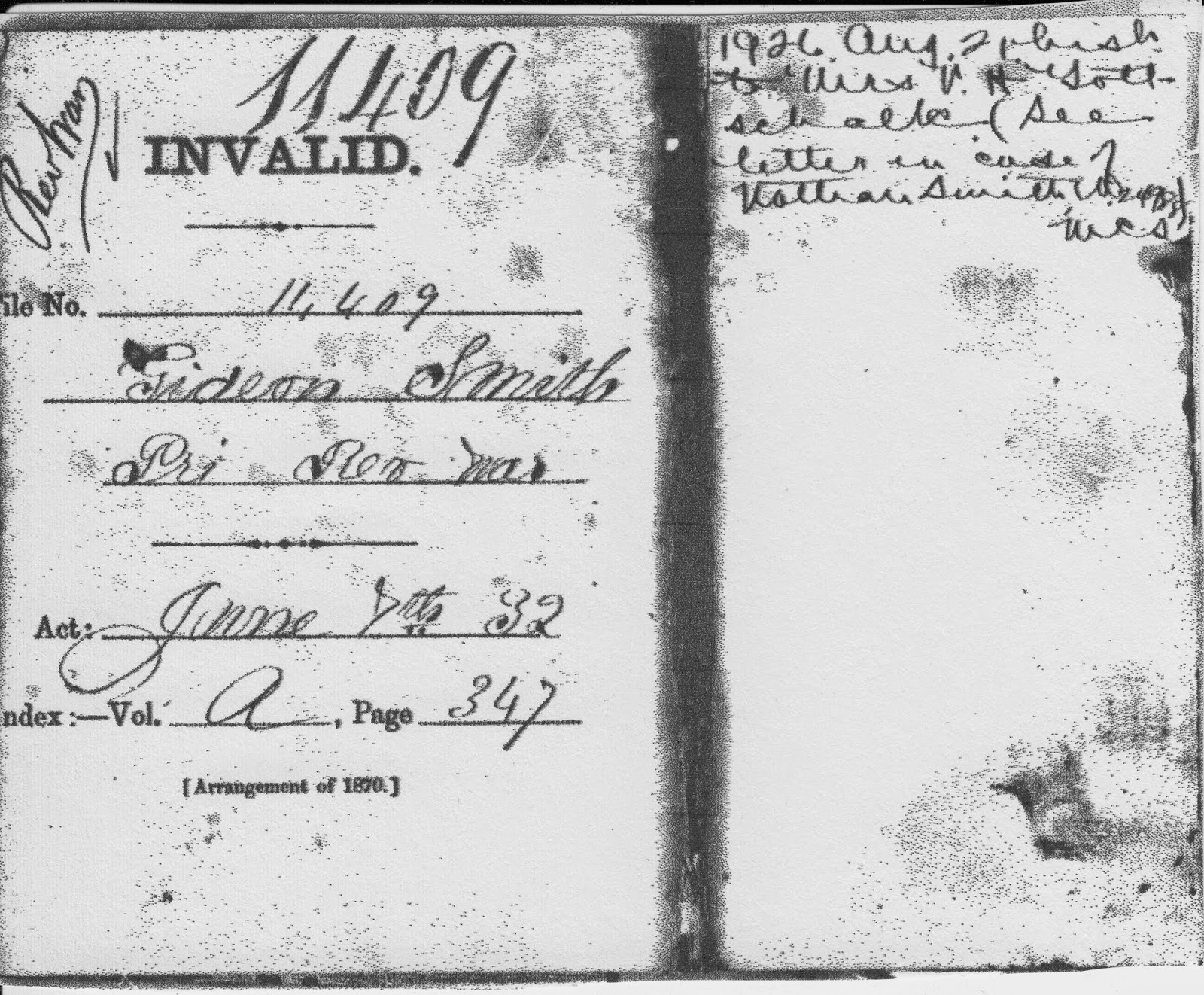
Gideon Smith
1752-1841

Lately I've been looking into the life and times of Gideon Smith, grandfather of my Civil War great grandfather.   Later in his life he became the Reverend Gideon Smith but I'm not there yet and don't know how he got to be a reverend.  The time I'm looking into is when he was a private during the Revolutionary War.

Available through the miracles of the internet are the US War Pension and Bounty-Land Warrant Application Files, where I was able to find pages and pages of documents relating to my ancestor's application for a war pension.  Many of  the pages were devoted to an extensive interview of Gideon by some military official in which many questions—both military and non-military—were  asked about his background. What a goldmine! I'll have to get back to those, but right now I'm on to see what else is in here. 


Next are some pages showing official letters of response to his application and....uh-oh, there's a problem here.  In spite of all the info my ancestor diligently provided, they're saying that there are some “obvious discrepancies”.  What are they talking about??  Do they mean his lack of an official record of birth?  He explained that he didn't have one, but he had seen in his father's bible, written in his father's own hand, the date of his birth.  And good grief, it was 1752!  Lots of people didn't have official birth records back then.  My own father, born in 1904, didn't have a birth certificate.  What do they want?  Well, until they get whatever it is they want, they're calling his claim "invalid".  Hrrumph! 


Okay, so I'll come back to that.  Let's move on and see what else we've got.  Hmm, here's a letter of inquiry from some woman  I've never heard of.  Her request was sent  in 1932.   What does she want? What business does she have going after the records of my great great grandfather?  Oh, I see—she's someone like me, someone doing family research, another descendent of Gideon's.  And actually, I'm glad she asked because here's a nice concise typewritten letter in response, outlining old Gideon's military history in one page—easy to save to my records.  I'll come back later and find out what exactly he did while he was serving in the military.  But right now, I need to keep on track. I need to find out:  Were those discrepancies resolved?  Did he ever get that pension? 

Watch this space.


Tuesday, October 28, 2014

Upper and Lower Lerbergs

The Lower Lerberg Farm


I went to Norway with modest expectations—cautious optimism. For instance, I did not go hoping to find any living relatives. My entire family from Valdres—my great-great grandparents and their ten children—left for the New World in 1849. My tiny family from Hallingdal—the other set of great-great grandparents and their two surviving children—made the journey in 1852. It is true that some of my great-greats had left siblings behind who might have produced peripheral cousins, but since I had no solid information on the existence of anyone who would qualify as being a cousin of mine, any pressure of searching for such a person was removed.


Another hope I did not harbor was that of finding the gravestones of my ancestors. I knew they wouldn't be there. There is limited space in the church yards, and if there are no living descendents to pay for the upkeep of the graves, those graves are given over to more recently deceased church members and the gravestones are yanked. Sometimes they are leaned against a wall of the church or against the graveyard fence for a while, so that some lucky searchers are able to find them before those expired markers are finally, inevitably, permanently disposed of. What's left of the contents of the grave are dug up to make room for a new occupant. And so I carried no illusions that, on lichen-covered gravestones, I might read the names that had become so familiar to me through my research. There was no one left to be buried or to tend to the buried.


I have to say, it did occur to me to wonder if, when I arrived in the town of Aal, I would look around at the faces in the streets or in the shops—and see people who looked like me. I had heard of that happening. In fact, one of the women in the Valdres group who was back for a second visit, told of just such an occurrence: She had gone to the farm where her ancestors had lived to meet a relative who was currently living there. When this relative opened the door and they saw each other face to face, Kristin thought she was looking in a mirror. I did not have such an experience, but it was no great loss or disappointment to me.


So, in the absence of gravestones or living relatives or spitting images, what was I hoping for? Well, it was this: To find the farms where my ancestors had lived and tilled the soil. That wish was in fact granted. In Hallingdal, I had the great fortune to find the Lerberg farm where Knud Halvorsen Lerberg, his wife Ragnild, his daughter Bergit (my great grandmother) and his son Peder, lived until 1852. And the way this came about, I never could have anticipated.


Shortly before I left for Norway, I had unexpectedly received an invitation from a Lars Stavehaug to attend his family reunion near the town of Aal, where the Lerberg farm was. Lars was a fellow Halling who had also made use of my genealogist's services, and she had put us in touch with each other. The reunion just happened to be scheduled during the time I would be in Hallingdal, so I happily accepted. I wasn't quite sure why I was being invited to a Stavehaug family reunion, but I thought, “Why not? Even though it isn't my family reunion, it's bound to be interesting. I won't be meeting relatives, but I might meet people whose ancestors were neighbors of my ancestors.” Well, to make a long story short, it turns out it was not a Stavehaug family reunion. The sign in the hotel lobby pointed the way to the location of ....drum roll, please....the Lerberg family reunion.


Now before you get too amazed, I have to remind you that the Lerberg name is the farm name and therefore does not necessarily indicate kinship. (See my Bergit Who? post.) And so the Lerbergs I met at this reunion did not share my DNA, but their ancestors lived where my Lerbergs lived. Well, actually, they lived near my Lerbergs. Because it was the Lower Lerberg farm that was home to Knud, Ragnild, Bergit and Peder—my Lerbergs. These present-day Lerbergs I was meeting were descended from the Upper Lerberg farm folk. I know, I know—it is increasingly convoluted, and I'm sorry.  


But the good news is that the following day, three cars full of Upper Lerbergs were planning to visit the family farm and they were willing to take this eager Lower Lerberg with them. From the Upper farm I was told I would be able to look down to see the fields of the Lower. Because of time constraints, it would not be possible to actually drive to it—it was not connected by road to the Upper. Even so, I was elated—I was to see the homestead.


The next morning arrived—gray , rainy, foggy. When, after several wrong turns, our caravan finally arrived at the Upper, we could barely see from the farm house to the barn, let alone to the field downhill from the farm. I contented myself with standing where I could look in the direction of the Lower Lerberg farm and imagine what it might look like. But then miraculously the clouds lifted and I could see! The field, the trees, a ramshackle building, the roof of another whose walls were hidden by encroaching woods. I could see them. Of course, it was still quite misty, so my photos of the Lerberg farm are a little Monet-like. But still...there it is, the Lower Lerberg farm!