Wednesday, February 21, 2018

52 Ancestors—Week 8 Prompt: Heirloom


The Chair


In the living room of our Denver home, a certain high-backed chair held pride of place between the fireplace and the stairway to the upper level. The woodwork of it scrolled and highly polished, the seat and backrest needle-pointed in Victorian fashion, it was a sight to behold. The backrest of the chair featured a portrait of a high-class lady with piled up hair.


But the great selling point of the chair was the back of the back, which I clearly remember as being sleek, silky velvet—a muted green. My sister Sally and I took great delight in drawing on the plush back with pointed finger, laying down the nap as we traced words or pictures, then miraculously erasing them by brushing over them in the opposite direction. Like ironing without the heat. We sometimes left each other messages on the back of that chair. And they were not nasty, I-hate-you messages. Unlike most of our interactions, this message-leaving activity was one in which we cooperated and in which we both found pleasure. Part of the fun was in seeing how long it took the other to find the hidden communication, because we certainly didn't check every day.

To be truthful, this chair was a bit of a monstrosity. No...that's too strong—an oddity, let's say. In my memory it was enormous, not all that comfortable, and somewhat out of place in the otherwise up-to-date furnishings of our living room. But we loved it—this white elephant/heirloom of ours.

The chair had come to us from Aunt Peg after she died. In fact, it was Aunt Peg's death which had made it possible for Mom and Dad to purchase this new house where the high-back chair was ceremoniously installed. The chair probably wouldn't have been Aunt Peg's choice either, but it was a family heirloom having been needle-pointed by Aunt Frank. (We all referred to her as Aunt Frank, but really she was the aunt of  Daddy and Aunt Peg.)

So, Aunt Peg died and there was Aunt Frank's chair and somebody had to have it. You can't just get rid of a chair that was needle-pointed by your ancestor. And so it resided at our family home until 1982, when Mom and Dad decided to leave Denver for the warmer environment of Chapel Hill—without the chair.

Sally had a three-story house, so her top floor was the obvious new home for it. The chair lived there a good twenty years until Sally moved into a Manhattan apartment, and some things had to go. You guessed it: the chair was one of them. Susan was already trying to downsize, and I was in a house so small that most of the living room was already taken up by my piano. The chair was sacrificed. Later, when I became a hoarder of all things family-related, I was shocked that I could have allowed such a thing to happen. How could I have let practicality trump tradition? I mourned the chair.

But wait!  It turns out that for fifteen years or so, the chair has been sitting, covered by a bedsheet, in Susan’s spare bedroom! It was when I was helping her clear out her house to put it on the market that we uncovered the heirloom. I rejoiced. How could I possibly have thought that we had given up our needle-pointed heirloom? As it must have happened, on that fateful day fifteen years ago, when we were about to consign the chair to the Salvation Army pile, Susan relented at the last moment. She took custody of the chair and has been housing it ever since. I had simply forgotten.

In my memory the chair was of hulking dimensions. In reality, it was small enough to be stowed in my Subaru Impreza hatchback to be hauled home to Vermont. Now, in my newer, somewhat larger house, it sits in the back room— crowded in with the piano. I am waiting for the day that I can pass it off to Abe and his sweetie when they become homeowners and can provide a good setting for the needle-pointed wonder. Maybe they will leave messages for each other on its velvety back.


Thursday, February 15, 2018

Valentine


When you first looked at this picture, did you think, "Huh? WAS? Was what?" Well, that was my thought too. Then I looked at the back of the photo and learned that W.A.S. was a social club at the Western Illinois Normal School where my grandmother Ellen and Arthur, her husband-to-be, were students.

Also on the back of the photograph was the inscription "February 14, 1906." Evidently the club was celebrating Valentine's Day—which also happened to be my grandmother's nineteenth birthday! 

Ellen is on the far left in the middle row. It is just possible that the young man in front of her is Arthur. He has the same jug-ears that I've seen in other pictures of my grandfather. But this kid hardly looks like he is twenty-seven, which is the age he would have been when Ellen was nineteen. I wish I knew how to use a facial recognition tool and where to get one.

I have so many questions about this little tableau: Is that Arthur? What does W.A.S. stand for? And what's up with the pictures pinned to some of the men's jackets? Pictures of themselves as babies perhaps? So many questions and nobody to ask.

Monday, February 12, 2018


Favorite Name


Keziah Bellomy was the older sister of my great-grandmother Lucinda Bellomy Odenweller. I always suspected that Keziah was a biblical name, and Wikipedia told me I had been right. Biblical Keziah, one of Job's three daughters, came to symbolize "female equality" because she received an inheritance from her father—not the usual order of things at the time.

I don't know that my Keziah inherited much financially when her father, an Illinois farmer, died in 1876. But, from the little I know of her life as a single woman of strong character and independence, I can't help but think that she lived up to her name.


Keziah was twenty-six and my great-grandmother twenty-one when they became surrogate mothers to their baby nephew Franklin. His mother had died and his father, their brother James, did not feel inclined to care for his four children on his own. I don't know where the baby's older siblings ended up, but Frank was lucky to land with his aunts. 


Keziah and Lucinda, both teachers, lived in their father Thomas's household. Their own mother had recently died, so caring for this motherless child must have been both a challenge and a balm.  When little Frank was nine years old, Lucinda married and took him with her. He continued to live with my great-grandparents until he married at the age of twenty-three.

Thomas died shortly before Lucinda's marriage in 1876, so I suppose the sisters sold the farm. Keziah moved in with her brother Josiah and his family, according to the 1880 US Census.


Then Keziah left her Illinois home and struck out on her own. She went out west, and lived an independent life—mostly as a school teacher and, later on, as a nurse. According to a US Land Office Record, on December 31, 1890 she bought a 160-acre parcel in Greeley, Kansas. So she must have been a farmer as well! 


Her obituary tells that she returned to Illinois for the last four years of her life, spending time with family members. This meant nephews and nieces (and possibly some cousins) because, at seventy-two, she had outlived all but one sibling—the brother who had left home to settle in New Mexico.


When Keziah reached the end of her adventurous (but perhaps lonely) life at the age of seventy-two, she was staying with her nephew Harry. It was in the home of Harry's father Josiah that Keziah had lived in the 1880s before her move to Kansas. Perhaps she and Harry had formed a special relationship during that period. I like to think of her passing her final days in the presence of a loving nephew.


Saturday, January 27, 2018

Another Favorite Photograph


This is the house in Moline, Illinois where my mother's Swedish grandparents lived with their six children. My great-grandmother Stina Ellstrom Ahl proudly poses with her brood in front of the house. If you zoom in on the photo you can see a ghostly figure in the window peering out on the proceedings. That would be Stina's husband, John Albert Ahl. Judging from the few things my mother ever said about her grandfather, that would seem to be in character. From my mother's perspective, he was kind of a loner, sat in his chair a lot reading his Swedish newspaper. It would be like him to literally take himself out of the picture.


My grandmother Ellen is the frowny little girl on the left. Next to her is her younger sister Lillie. The other girl on the bench is Aunt Phoebe, the oldest of the Ahl children. And the little one in the long white dress standing in front of the bench? That's my mother's Uncle Herbert! On the porch in a high chair is baby Aunt Mabelle. Uncle Leonard has not yet been born, placing this photo in about 1895.

I'm guessing that this house may have become the Ahl family's home shortly before the picture was taken. The newly planted sapling to the left, the somewhat make-shift wooden walkway from the street to the front door, and what might be the beginning stages of a fence—all the kind of projects that new homeowners might undertake.

In 2015 I took a trip to Moline to do some family research, and I located the house at 1029 17th Avenue. It was still recognizable in spite of having been turned into a duplex. The center window on the second floor had evidently been sacrificed in the remodeling. Gone also was the detailed trim of the porch and the roof, replaced with skimpier, more utilitarian material. And I'm pretty sure that that is aluminum siding in place of the wooden clapboards on the original house. The sapling either never matured at all and died, or it grew too big, cast too much shade, and was felled. The wooden walkway was replaced with a cement sidewalk. Still, the basic appearance of the old Ahl home is nearly the same almost one-and-a-quarter century later.


Sunday, January 14, 2018

Longevity


I decided to make a chart showing the birth and death dates for my ancestors going back as far as I could. The winner in the longevity contest was Jane Love Hays, my 4th great-grandmother. Mind you, I have neither birth or death documents proving this. I have only the following: some biographical information posted on Find a Grave; a Hays family history written by my great-grandfather's brother (Jane Love's great- grandson); applications from three descendants wishing to become members of the Sons of the American Republic.

One part of the SAR application form requires the applicant to trace their lineage back to their Revolutionary hero by providing the names and birth and death dates of the intervening ancestors. I suspect that SAR applicants are prone to engaging in the same copy-cat documentation that is found on Ancestry.com and other online family trees. One SAR wannabe latches on to some piece of information that another one has written, uses it in his own application, and there you go.

The first two descendants I found who were seeking SAR membership claimed that Jane Love was born in 1712 and died in 1806, making her 94 years old at the time of her death.


I'd always been puzzled by this birth date for Jane. If 1712 was indeed the year she was born, that means that she was 12 when she married. Did they do that back then? I suppose it's possible, but I always suspected that there was an error in there somewhere.

Then I found the third SAR applicant who did not run with the herd. He named the much more reasonable year of birth as 1702, making Jane a 22-year-old bride. Of course that means she would have died at the age of 104. So which is more likely—that Jane was a bride at the age of twelve or that she lived to be a hundred and four years old? For the purposes of this longevity assignment, it doesn't matter. To the best of my knowledge, the closest runner-up only reached the age of 89. So either way—94 or 104—Jane Love Hays wins hands down.  Love conquers all.

Tuesday, January 9, 2018


The Driver in the Family


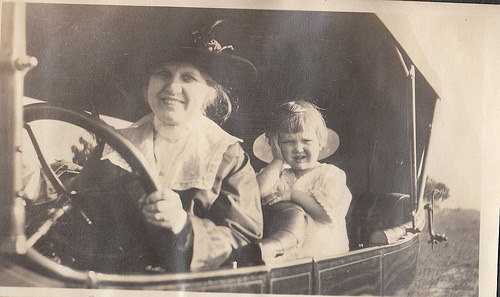
Lillie Ahl Johnson driving--Rowena Ahl Odenweller riding


When I went to visit the ninety-year-old husband of my mother's cousin a couple years ago, I asked him to tell me about Aunt Lillie—his mother-in-law and my mother's aunt. Cal told me a little about her character, saying that she was gentle and thoughtful but also had her own opinions and stood her ground. He then volunteered that Lillie was “the driver in the family.” Oh, her husband knew how to drive and was willing to take the wheel for short distances, but Lillie loved to drive. On long trips, it was Lillie who did the driving.

Well, this made me sit up straight. I recently had acquired an old photo of a happy-looking woman with hair in wild disarray, sitting in the driver's seat of an open-top car. In the backseat was my happy-looking mother—about age three. I had suspected that the driver was Aunt Lillie, based on her resemblance to the young woman in other photos that I had of the siblings in the Ahl family. It made sense: At that time my mother would still have been the only grandchild and so it was likely that she would be taken for jaunts by her doting aunt.

I pulled up the scanned copy on my laptop and showed it to Cal. He allowed as how it did look like Lillie. He didn't swear to it. But I myself am now confident that this photo is of Lillie—the driver in the family.


Monday, January 8, 2018


My Grandfather's Slow Start


My grandfather, Arthur Leonard Odenweller, got off to a slow start in what turned out to be a long and productive career in education. By his own account, he was a sickly child and as a consequence he missed quite a number of school days in his early education. But he was bright and determined and so he easily handled the work offered in the Schuyler County (Illinois) public schools.

He went on to complete a business course at the Rushville Commercial School, also known as Kennedy's Normal School. He and his younger sister, Eula, overlapped in their studies there, and they are shown together in this class photo. He graduated in 1900, she in 1901. 

Arthur is the farthest on the left. Eula is in front of him.

In 1902 their mother died, and the following year Eula herself died in a horse-and-buggy accident. Arthur, also in the buggy, survived. Perhaps the pain of these losses made it difficult for him to focus and find his direction. I don't know the exact timing of events, but I do know that at some point after his business course, he spent time at Eureka College. It evidently was not to his liking because he only stayed one year. What did he do to fill the years between Eureka and his next academic attempt? Maybe his father needed him on the farm? As puny as he was, it's difficult picturing him doing physical labor, so maybe he helped on the management end of things?

It wasn’t until he was twenty-six years old that he enrolled at Western State Normal School in Macomb where his younger brother was already studying. Claude graduated ahead of Arthur.

It was there at the Normal School that Arthur finally seems to have found his feet. Not only did he meet my grandmother there, but he was quite taken with the education program which had a strong focus on developing curriculum for rural schools. He and Ellen both graduated from the two-year program in 1907. Here are their photos as they appeared in the school’s yearbook, the Sequel.


They both went on to complete another two-year course of study in Macomb. According to their profiles in an exceedingly long-titled book(1),  Arthur received “an advanced diploma—in recognition of his excellence in teaching.” Ellen was awarded “an advanced diploma for superior excellence in teaching.” (Emphasis mine.) Guess who went on to become a teacher, principal, and superintendent while the other kept house and raised their two daughters, working intermittently as a substitute teacher. But this did not happen immediately.

First of all, straight out of Western State Normal, Arthur landed a job as teaching principal in the little school in Pleasant View near the town where he had grown up. This was followed by other teaching or administrative positions in other Schuyler County schools for a couple years. Finally he'd worked his way up—both administratively and geographically speaking—to Henry County to become the superintendent of schools there. Rock Island County, where his sweetheart lived, was just north of Henry County and I'm sure it was all part of their plan. They were married in 1911.

The timeline after this gets a little fuzzy for me. I'm depending on my memory of what my mother told me about the course of events. I believe that Arthur felt the need to get an advanced degree, and so he went to New York City to the Teachers College at Columbia University for his master's. Ellen, not wanting to uproot my mother and my aunt, stayed behind at her parents' house in Moline. According to the 1920 Census, my grandfather had found lodgings at a boarding house with forty-four other boarders! 

He must have left New York right after the census, because an article in the Davenport Democrat and Leader stated that he had been the principal in Davenport (Iowa) schools between 1920-1921. He then served as superintendent of schools in Belleville, Illinois, leaving the position in 1924 when he was appointed head of the education department at Lindenwood College in St. Charles, Missouri.

So things were looking good, it seemed. The family was together and he was moving up. But after three years, the administration at Lindenwood let him know that to continue there, he would need to get his doctorate. So off he went, leaving his family again, and spent the next several years researching and writing his dissertation—this time at the University of Chicago. According to my mother, even though he had complied with Lindenwood's requirements, when he came back his job was not there! I think it had to do with the Depression. The only job he could find was as a night desk clerk at a hotel in Chicago.

It may have been at that point that Arthur and Ellen decided to start their own school. (Did you see how I did that? How I worked in a second “start”?) By this time, both daughters were out of the house, so Ellen joined Arthur in Chicago. They called their new venture the Chicago College Preparatory School. They taught together until her sudden death at the age of fifty-three. He soldiered on alone for several years after that, but I think that eventually the number of students feeling the need to prepare for college dwindled. He took on a second job working at C.G. McClurg, a Chicago publishing company. My sisters and I were happy with this arrangement because it meant that he sent us children's books, the most memorable being giant (three-foot-tall, two-foot-wide) Dick and Jane books. We only met our grandfather a couple of times, we each received a few letters from him—kindly, formal, reserved, over our heads. But the Dick and Jane books were with us for many years and never got old.

(1) Educational History of Illinois, Growth and Progress in Educational Affairs of the State from the Earliest Day to the Present, with Portraits and Biographies, John William Cook, 1912.