The Old Homestead
Sunday, April 1, 2018
Tuesday, March 20, 2018
52 Ancestors Week 10 prompt: Strong Woman
A Strong Woman
Barbro Helgesdatter Aasli Gaarder must have been a strong woman. At least I hope she was. But when I see the haunted look on her face in the only photo I have of her, I have to wonder.
I can only guess at how she might have responded to the difficult events in her life. There are no letters between Barbro and friends or family members, no diary. All I have to go on are the antiseptic census records, dates of births and deaths, accounts of her husband's achievements, and her obituary.
Barbro was a month shy of seventeen years when she gave birth to her first child, and she continued to bear another child about every other year until she had produced thirteen. That alone should qualify her as a strong woman.
And then consider that in 1849 she and her husband Syver Guttormsen Gaarder left their farm and all that made up their life in the Valdres valley of Norway to make a new home in Wisconsin. In the port of Drammen, they boarded the sailing ship Benedicte with their brood, which at the time numbered ten. The youngest was four months old when they sailed. They spent the next ten weeks at sea. When they arrived in the New York harbor they still had to make their way to the Erie Canal, to Milwaukee, and from there to the parsonage in Rock County where they were expected. The pastor there offered temporary shelter for immigrating Norwegians until they could find land on which to settle.
Barbro's husband left her at the parsonage with the ten children in order to scout out land in nearby Green County. Granted, her oldest children were in their twenties, and she had a twenty-three-year-old daughter-in-law, so presumably she had help—but still!
Syver did indeed find land in Green County and bought 160 acres in the township of Albany. There was already a log house in place and that is where, with an addition built onto it, the family of thirteen lived. When a few more Norwegian families came along to settle in Albany, the Gaarder's log home also became the meeting place for church and school. I picture Barbro managing not just a household, but a community center! To have no privacy, to be responsible for accommodating the whole community! To me that sounds like quite a bit of responsibility. But of course I have no way of knowing how Barbro felt about all of this. Perhaps, rather than being burdened, she enjoyed the company of all those people. Perhaps they provided a lot of support.
Once settled in Albany, Barbro continued to have babies. But just weeks after baby Ellef came along in February of 1851, her daughter Live died at the age of eighteen. How did Barbro bear it? Another baby, Sever, arrived in 1853. Things were quiet until 1855 when Guttorm, her first-born, fell from the top of a haystack, landed on the prongs of a pitchfork piercing his intestines. He died within a couple of days. About ten months later, on her own birthday, Barbro gave birth to her final child, Julia Gunhild.
Barbro was forty-six, had given birth to thirteen children, had seen two die, and still had another forty years or so to live. To the best of my knowledge, her next big loss was the death of her husband in 1881. Syver was about ten years her senior and died when Barbro was seventy-one. She had sixteen more years to live. Hopefully she was able to enjoy her prodigious family for a good long time before she had the stroke that immobilized her for the last three years of her life. To quote from her obituary,
- Through her whole life, she was a faithful and devoted member of her church, and until sickness deprived her of her power of speech, she frankly confessed her faith in the atoning sacrifice of her Savior.
- But then, you know how obituaries are: the subjects always face life bravely, never lose their faith, always die with equanimity. How much can one believe in a characterization in an obituary?
- As I say, I can only hope that my great-great-grandmother Barbro was strong.
- Melissa Hays →Thad Hays →Hannah Gaarder →Helge Gaarder →Barbro Helgesdatter Gaarder
Sunday, March 11, 2018
52 Ancestors Week 9: Where There's a Will
Where There's a Will...
![]() |
| Sister Susan with James Hays's Will |
In
a card catalog drawer in the Bellefonte Historical Museum, I found a
card with my third great-grandfather's name on it: James Hays. My
sister Susan and I had traveled to Pennsylvania in search of
information about any Hays ancestor, and here was a card
promising information regarding our Revolutionary War ancestor who
settled here in Centre County. James had lived, raised his family,
and died in the small town of Beech Creek near Bellefonte. The card
indicated there was a will to be had.
I
took the card over to the librarian, expecting her to tell me that to
see the will I would need to go over to the county courthouse. I was
not looking forward to walking uphill in the heat to get to the
courthouse, so I was relieved to learn that the will resided right
there in the building we were in. Down in the basement. She said
she'd go downstairs to retrieve it. That is, if she could get
to it. They were doing some remodeling down there, so the box with my
will just might be in an inaccessible part of the basement. As she
made her descent, my sister Susan, a former historical society
archivist herself, made some dire comments on the unsuitability of
basements as storage spaces. I waited apprehensively, fearing that
the librarian would return empty-handed or bearing a disintegrating,
moldy, unreadable will. But when she came back upstairs she presented
us with a lily-white packet, measuring about 4x7 inches, bound by a
white ribbon tied in a bow.
Susan
and I began to unpack the envelope which contained not just a will,
but every document that had anything to do with the administration of
the will: an inventory of all of my ancestor's possessions, a
document naming the executor and witnesses of the will, and many tiny
scraps of paper that I believed to be receipts signed by the various
beneficiaries, stating what had been distributed to them.
I
loved the inventory—One Heifer...One Stear...Two Horses with their
Geers...Small Speckled D° (I have no idea!)...Harrow pins, etc. Also
listed was income from the sale of land in nearby Lycoming County.
All told, eleven farm items, nine household items, and two bonds were
listed. Total value? $2190.16.
![]() |
| First page of inventory |
The
next thing I loved about the will was that a witness and executor of
it was another third great-grandfather of mine! Gideon Smith
and James Hays were each father-in-law to the other's child. Gideon's
daughter Susannah Sally married James's son Samuel. Although James
was a good twelve years older than Gideon, they were good friends. In
designating Gideon an executor of his will, James refers to him as a
Trusty friend.
![]() |
| Signature of Gideon Smith |
When it came to the unfolding of the tiny scrap receipts, I began to get nervous that we'd never get them refolded and back in the right order. It did occur to me that maybe I didn't need to worry. Was there anyone else in the world who would ever care, who would be wanting to look at this will packet again? (Come to think of it, was there ever anyone before me who had opened this envelope? Or was the first time since my ancestor's death that his will and all its accompanying documents had ever seen the light of day?) I decided that, in order to cause the least disruption possible, I would take a photo of one receipt--with Susan holding down the corners to keep it flat--just to have as an example. The one I photographed was a receipt signed by one of Gideon's sons!
![]() |
Finally
I came to the will itself. I checked the exact date and learned that
James had made out his will a few weeks before his death. The
language took me back to the world of 1817: Knowing that it is
apointed for all Men once to die I so make and publish this my Last
will and Testament.
The
first beneficiary, of course, was his wife Sarah Brown Hays, my third
great-grandmother. The provisions he made for his helpmeet of
fifty-eight years I found quite touching.To
Sarah, James bequeathed the following: two bonds of fifty pounds
each, one bed and beding, one cow (her choice of the flock,) six
sheep, a set of drawers, one-third of the kitchen furniture,
one-fourth of the chairs, and the fire irons. (Evidently all of
the fire irons as no others were designated for other heirs.) Sarah
was also guaranteed the use of the room where I now ly. I
pictured the scribe sitting next to the bed of the dying James Hays,
writing down all his wishes. Was it an attorney? Would it have to
have been an attorney or could anybody have recorded what James
dictated as long as Gideon and the neighbor, William Feron, were
there to witness it? (There's so much I don't know about wills!)
James
further orders that their son, my second great-grandfather Samuel,
find her a horse to ride when she chuses. Later on in the will
he specifies that she and their one unmarried daughter will stay in
the house as long as it suits them and that Samuel, again, will see
that they live in as comfortable acomodations as they have
heretofore had.
Poor
Samuel, the youngest of the family, in charge of everything. Only
twenty-five years old at the time of his father's death, he is
suddenly responsible for sorting out everything—the running of the
farm and seeing that the needs of his mother and his maiden sister
are met. Why doesn't his brother John have to do any of the heavy
lifting? After all, he is the older son and doesn't live that far
away. But maybe Samuel is the responsible one, the one who had stayed
on the scene to farm alongside his father, the one who knows what's
what. I'm sure James had his reasons.
One
final gem I found in the will was the following: I likewise have a Claim of Land in the State of Kaintuckey if it is Recovered it is my will that it be Equally Divided amongst my Sons and Daughters
I had read in other sources that Lieutenant James Hays had received three tracts of land as payment for his military service in both the French and Indian War and the American Revolution. One was the Beech Creek property, the second was also in Pennsylvania. But I had never been able to determine the location of the third claim and had always been curious about why he had never followed up on it. Now I'm wondering if, in that packet in the Bellefonte basement, there might be an overlooked scrap of paper holding that information. Perhaps the executors of James's will had attempted to track down the Kaintuckey claim and had reported their success or failure in finding it. (As I say, I know very little about how these things work. Maybe a Wills 101 course should be next in my genealogy self-education.)
James Hays died on February 14, his wife's birthday, in 1817. He was seventy-six years old.
Wednesday, February 21, 2018
52 Ancestors—Week 8 Prompt: Heirloom
The Chair
In the living room of our Denver home, a certain high-backed chair held pride of place between the fireplace and the stairway to the upper level. The woodwork of it scrolled and highly polished, the seat and backrest needle-pointed in Victorian fashion, it was a sight to behold. The backrest of the chair featured a portrait of a high-class lady with piled up hair.
To be truthful, this chair was a bit of a monstrosity. No...that's too strong—an oddity, let's say. In my memory it was enormous, not all that comfortable, and somewhat out of place in the otherwise up-to-date furnishings of our living room. But we loved it—this white elephant/heirloom of ours.
The chair had come to us from Aunt Peg after she died. In fact, it was Aunt Peg's death which had made it possible for Mom and Dad to purchase this new house where the high-back chair was ceremoniously installed. The chair probably wouldn't have been Aunt Peg's choice either, but it was a family heirloom having been needle-pointed by Aunt Frank. (We all referred to her as Aunt Frank, but really she was the aunt of Daddy and Aunt Peg.)
So, Aunt Peg died and there was Aunt Frank's chair and somebody had to have it. You can't just get rid of a chair that was needle-pointed by your ancestor. And so it resided at our family home until 1982, when Mom and Dad decided to leave Denver for the warmer environment of Chapel Hill—without the chair.
Sally had a three-story house, so her top floor was the obvious new home for it. The chair lived there a good twenty years until Sally moved into a Manhattan apartment, and some things had to go. You guessed it: the chair was one of them. Susan was already trying to downsize, and I was in a house so small that most of the living room was already taken up by my piano. The chair was sacrificed. Later, when I became a hoarder of all things family-related, I was shocked that I could have allowed such a thing to happen. How could I have let practicality trump tradition? I mourned the chair.
But wait! It turns out that for fifteen years or so, the chair has been sitting, covered by a bedsheet, in Susan’s spare bedroom! It was when I was helping her clear out her house to put it on the market that we uncovered the heirloom. I rejoiced. How could I possibly have thought that we had given up our needle-pointed heirloom? As it must have happened, on that fateful day fifteen years ago, when we were about to consign the chair to the Salvation Army pile, Susan relented at the last moment. She took custody of the chair and has been housing it ever since. I had simply forgotten.
In my memory the chair was of hulking dimensions. In reality, it was small enough to be stowed in my Subaru Impreza hatchback to be hauled home to Vermont. Now, in my newer, somewhat larger house, it sits in the back room— crowded in with the piano. I am waiting for the day that I can pass it off to Abe and his sweetie when they become homeowners and can provide a good setting for the needle-pointed wonder. Maybe they will leave messages for each other on its velvety back.
Thursday, February 15, 2018
Valentine
When you first looked at this picture, did you think, "Huh? WAS? Was what?" Well, that was my thought too. Then I looked at the back of the photo and learned that W.A.S. was a social club at the Western Illinois Normal School where my grandmother Ellen and Arthur, her husband-to-be, were students.
Also on the back of the photograph was the inscription "February 14, 1906." Evidently the club was celebrating Valentine's Day—which also happened to be my grandmother's nineteenth birthday!
Ellen is on the far left in the middle row. It is just possible that the young man in front of her is Arthur. He has the same jug-ears that I've seen in other pictures of my grandfather. But this kid hardly looks like he is twenty-seven, which is the age he would have been when Ellen was nineteen. I wish I knew how to use a facial recognition tool and where to get one.
I have so many questions about this little tableau: Is that Arthur? What does W.A.S. stand for? And what's up with the pictures pinned to some of the men's jackets? Pictures of themselves as babies perhaps? So many questions and nobody to ask.
Monday, February 12, 2018
Favorite Name
Keziah Bellomy was the older sister of my great-grandmother Lucinda Bellomy Odenweller. I always suspected that Keziah was a biblical name, and Wikipedia told me I had been right. Biblical Keziah, one of Job's three daughters, came to symbolize "female equality" because she received an inheritance from her father—not the usual order of things at the time.
I don't know that my Keziah inherited much financially when her father, an Illinois farmer, died in 1876. But, from the little I know of her life as a single woman of strong character and independence, I can't help but think that she lived up to her name.
Keziah was twenty-six and my great-grandmother twenty-one when they became surrogate mothers to their baby nephew Franklin. His mother had died and his father, their brother James, did not feel inclined to care for his four children on his own. I don't know where the baby's older siblings ended up, but Frank was lucky to land with his aunts.
Keziah and Lucinda, both teachers, lived in their father Thomas's household. Their own mother had recently died, so caring for this motherless child must have been both a challenge and a balm. When little Frank was nine years old, Lucinda married and took him with her. He continued to live with my great-grandparents until he married at the age of twenty-three.
Thomas died shortly before Lucinda's marriage in 1876, so I suppose the sisters sold the farm. Keziah moved in with her brother Josiah and his family, according to the 1880 US Census.
Then Keziah left her Illinois home and struck out on her own. She went out west, and lived an independent life—mostly as a school teacher and, later on, as a nurse. According to a US Land Office Record, on December 31, 1890 she bought a 160-acre parcel in Greeley, Kansas. So she must have been a farmer as well!
Her obituary tells that she returned to Illinois for the last four years of her life, spending time with family members. This meant nephews and nieces (and possibly some cousins) because, at seventy-two, she had outlived all but one sibling—the brother who had left home to settle in New Mexico.
When Keziah reached the end of her adventurous (but perhaps lonely) life at the age of seventy-two, she was staying with her nephew Harry. It was in the home of Harry's father Josiah that Keziah had lived in the 1880s before her move to Kansas. Perhaps she and Harry had formed a special relationship during that period. I like to think of her passing her final days in the presence of a loving nephew.
Saturday, January 27, 2018
Another Favorite Photograph
This
is the house in Moline, Illinois where my mother's Swedish
grandparents lived with their six children. My great-grandmother
Stina Ellstrom Ahl proudly poses with her brood in front of the
house. If you zoom in on the photo you can see a ghostly figure in
the window peering out on the proceedings. That would be Stina's
husband, John Albert Ahl. Judging from the few things my mother ever
said about her grandfather, that would seem to be in character. From
my mother's perspective, he was kind of a loner, sat in his chair a
lot reading his Swedish newspaper. It would be like him to literally
take himself out of the picture.
My
grandmother Ellen is the frowny little girl on the left. Next to her
is her younger sister Lillie. The other girl on the bench is Aunt
Phoebe, the oldest of the Ahl children. And the little one in the
long white dress standing in front of the bench? That's my mother's
Uncle Herbert! On the porch in a high chair is baby Aunt Mabelle.
Uncle Leonard has not yet been born, placing this photo in about
1895.
I'm
guessing that this house may have become the Ahl family's home
shortly before the picture was taken. The newly planted sapling to
the left, the somewhat make-shift wooden walkway from the street to
the front door, and what might be the beginning stages of a fence—all
the kind of projects that new homeowners might undertake.
In
2015 I took a trip to Moline to do some family research, and I
located the house at 1029 17th Avenue. It was still recognizable in
spite of having been turned into a duplex. The center window on the
second floor had evidently been sacrificed in the remodeling. Gone
also was the detailed trim of the porch and the roof, replaced with
skimpier, more utilitarian material. And I'm pretty sure that that is
aluminum siding in place of the wooden clapboards on the original
house. The sapling either never
matured at all and died, or it grew too big, cast too much shade, and
was felled. The wooden walkway was replaced with a cement sidewalk.
Still,
the basic appearance of the old Ahl home is nearly the same almost
one-and-a-quarter century later.
Sunday, January 14, 2018
Longevity
I decided to make a chart
showing the birth and death dates for my ancestors going back as far
as I could. The winner in the longevity contest was Jane Love Hays,
my 4th great-grandmother. Mind you, I have neither birth
or death documents proving this. I have only the following: some
biographical information posted on Find a Grave; a Hays family
history written by my great-grandfather's brother (Jane Love's great-
grandson); applications from three descendants wishing to become members of
the Sons of the American Republic.
One part of the SAR
application form requires the applicant to trace their lineage back
to their Revolutionary hero by providing the names and birth and
death dates of the intervening ancestors. I suspect that SAR
applicants are prone to engaging in the same copy-cat documentation
that is found on Ancestry.com and other online family trees. One SAR
wannabe latches on to some piece of information that another one has
written, uses it in his own application, and there you go.
The first two descendants I found who were seeking SAR membership claimed that Jane Love was born in 1712 and
died in 1806, making her 94 years old at the time of her death.
I'd always been puzzled by
this birth date for Jane. If 1712 was indeed the year she was born,
that means that she was 12 when she married. Did they do that
back then? I suppose it's possible, but I always suspected that there
was an error in there somewhere.
Tuesday, January 9, 2018
The Driver in the Family
![]() |
| Lillie Ahl Johnson driving--Rowena Ahl Odenweller riding |
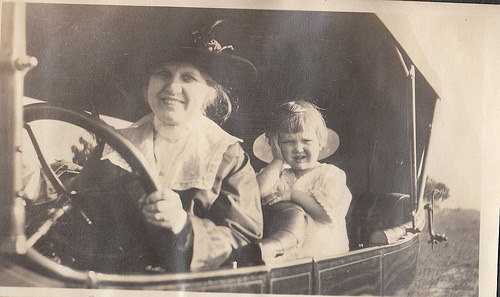
Well, this made me sit up straight. I recently had acquired an old photo of a happy-looking woman with hair in wild disarray, sitting in the driver's seat of an open-top car. In the backseat was my happy-looking mother—about age three. I had suspected that the driver was Aunt Lillie, based on her resemblance to the young woman in other photos that I had of the siblings in the Ahl family. It made sense: At that time my mother would still have been the only grandchild and so it was likely that she would be taken for jaunts by her doting aunt.
I pulled up the scanned copy on my laptop and showed it to Cal. He allowed as how it did look like Lillie. He didn't swear to it. But I myself am now confident that this photo is of Lillie—the driver in the family.
Monday, January 8, 2018
My Grandfather's Slow Start
My grandfather, Arthur Leonard
Odenweller, got off to a slow start in what turned out to be a long
and productive career in education. By his own account, he was a
sickly child and as a consequence he missed quite a number of school
days in his early education. But he was bright and determined and so
he easily handled the work offered in the Schuyler County (Illinois)
public schools.
He
went on to complete a business course at the Rushville Commercial
School, also known as Kennedy's Normal School. He and his younger
sister, Eula, overlapped in their studies there, and they are shown
together in this class photo. He graduated
in 1900, she in 1901.
![]() |
| Arthur is the farthest on the left. Eula is in front of him. |
In 1902 their mother died, and the following year Eula herself died in a horse-and-buggy accident. Arthur, also in the buggy, survived. Perhaps the pain of these losses made it difficult for him to focus and find his direction. I don't know the exact timing of events, but I do know that at some point after his business course, he spent time at Eureka College. It evidently was not to his liking because he only stayed one year. What did he do to fill the years between Eureka and his next academic attempt? Maybe his father needed him on the farm? As puny as he was, it's difficult picturing him doing physical labor, so maybe he helped on the management end of things?
It wasn’t until he
was twenty-six years old that he enrolled at Western State
Normal School in Macomb where his younger brother was
already studying. Claude graduated ahead of Arthur.
It was there at the Normal
School that Arthur finally seems to have found his feet. Not only did
he meet my grandmother there, but he was quite taken with the
education program which had a strong focus on developing curriculum
for rural schools. He and Ellen both graduated from the two-year
program in 1907. Here are their photos as they appeared in the
school’s yearbook, the Sequel.
They
both went on to complete another two-year course of study in
Macomb. According to their profiles in an exceedingly
long-titled book(1), Arthur received “an advanced
diploma—in recognition of his excellence in teaching.” Ellen
was awarded “an advanced diploma for superior excellence
in teaching.” (Emphasis mine.) Guess who went on to
become a teacher, principal, and superintendent while the other kept
house and raised their two daughters, working intermittently as a
substitute teacher. But this did not happen immediately.
First
of all, straight out of Western State Normal, Arthur landed a job as
teaching principal in the little school in Pleasant View near the
town where he had grown up. This was followed by other teaching or
administrative positions in other Schuyler County schools for a
couple years. Finally he'd worked his way up—both administratively
and geographically speaking—to Henry County to become the
superintendent of schools there. Rock Island County, where his
sweetheart lived, was just north of Henry County and I'm sure it was
all part of their plan. They were married in 1911.
The
timeline after this gets a little fuzzy for me. I'm depending on my
memory of what my mother told me about the course of events. I
believe that Arthur felt the need to get an advanced degree, and so
he went to New York City to the Teachers College at Columbia
University for his master's. Ellen, not wanting to uproot my mother
and my aunt, stayed behind at her parents' house in Moline. According
to the 1920 Census, my grandfather had found lodgings at a boarding
house with forty-four other boarders!
He
must have left New York right after the census, because an article in
the Davenport Democrat and Leader stated that he had
been the principal in Davenport (Iowa) schools between 1920-1921. He
then served as superintendent of schools in Belleville, Illinois,
leaving the position in 1924 when he was appointed head of the
education department at Lindenwood College in St. Charles, Missouri.
So
things were looking good, it seemed. The family was together and he
was moving up. But after three years, the administration at
Lindenwood let him know that to continue there, he would need to get
his doctorate. So off he went, leaving his family again, and spent
the next several years researching and writing his dissertation—this
time at the University of Chicago. According to my mother, even
though he had complied with Lindenwood's requirements, when he came
back his job was not there! I think it had to do with the Depression.
The only job he could find was as a night desk clerk at a hotel in
Chicago.
It
may have been at that point that Arthur and Ellen decided to start
their own school. (Did you see how I did that? How I worked in a
second “start”?) By this time, both daughters were out of the
house, so Ellen joined Arthur in Chicago. They called their new
venture the Chicago College Preparatory School. They taught together
until her sudden death at the age of fifty-three. He soldiered on
alone for several years after that, but I think that eventually the
number of students feeling the need to prepare for college dwindled.
He took on a second job working at C.G. McClurg, a Chicago publishing
company. My sisters and I were happy with this arrangement because it
meant that he sent us children's books, the most memorable being
giant (three-foot-tall, two-foot-wide) Dick and Jane books. We only
met our grandfather a couple of times, we each received a few letters
from him—kindly, formal, reserved, over our heads. But the Dick and
Jane books were with us for many years and never got old.
(1)
Educational History of Illinois, Growth and Progress in Educational
Affairs of the State from the Earliest Day to the Present, with
Portraits and Biographies, John William Cook, 1912.
Friday, September 29, 2017
My Father's Bank
This
morning I visited the Davenport Bank and Trust Company where my
father worked as a teller before he met Mom. I think that during the
time Sally and Susan were little he moved up to a position in the
trust department.
On
the last night of my 2015 visit, my Airbnb host had driven me over to
see the elegant exterior of the classic structure. He told me the
bank space was empty now but if I ever came back to the Quad Cities,
I should go to the bank during the daytime and ask to see the inside
with its impressive murals.
Easier
said than done. When I showed up today, it was locked up tight and
nobody was around to ask for information. After a little hunting, I
spotted three people in a soulless glassed-in lobby annexed to the
original bank building. It was locked too, but I rapped on the glass
of the double doors and interrupted the woman who apparently was
giving a briefing or making a pitch to the two men. She came over and
we talked through the crack between the doors. At first she told me
the old bank was not open to the public. When I told her that my
father had worked there, she grudgingly agreed to let me in if I
would go to the entrance on the other side of the building.
I gratefully scurried around the corner to be admitted to the cavernous space. The woman had brought the two men with her and they continued the briefing in the hallway just outside the bank—with the door open so she could keep an eye on me.
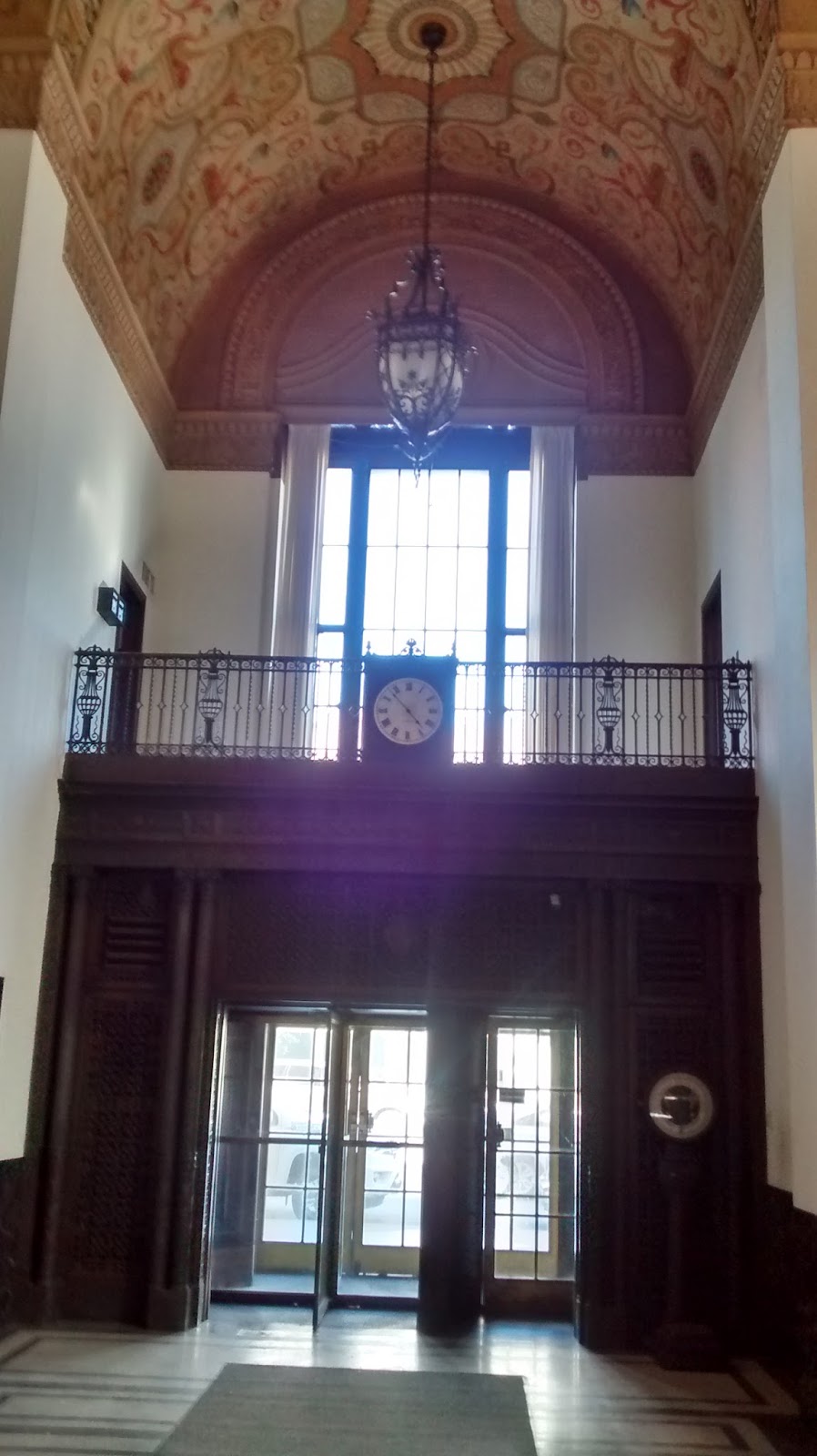
A little self-consciously, I roamed around taking photos of the soaring vaulted ceiling, the mid-western-themed murals, the intricately scrolled chandeliers, the tellers' windows with their grills. So many tellers' windows! Probably ten or twelve of them.
I tried to divine which one my father had stood behind. But then maybe the tellers didn't have permanently assigned windows. Maybe they rotated on a predetermined schedule. Or maybe there was one plum window that they all vied for in a free-for-all, first-come-first-served fashion. Or maybe the plum window was awarded to a particular teller in recognition of exceptional performance. And conversely, one dreaded window—a window that attracted the most demanding customers—may have been assigned to a teller as punishment for some infraction.
I pulled myself back from my wool-gathering to focus again on my father working in that space. Did he marvel at his luck to have a job in a veritable museum? Did he look forward to going to work so that during down-times he could study the paintings and admire the abundance of stenciling and scroll work? Or, as it happens with any daily routine, did he cease to notice his surroundings? I never heard him say.
Subscribe to:
Posts (Atom)